
Some of the links on this page are affiliate links. When you make a purchase through an affiliate link, I earn a commission at no cost to you. See my entire disclosure policy for all the boring details.
$450 a month on high protein, healthy dinners? For a large family? In THIS economy?
I hear you. Grocery prices have gone up, everything feels more expensive, and a lot of people are starting to wonder how anyone feeds a big family without going broke. But here’s the good news — it’s absolutely doable. I cook dinner for my family of seven (that’s two adults and five kids) for $300 to $400 a month, and we eat real, hearty food every single night.
The price is dinners alone… I spend more than that each month when you factor in breakfast, lunch, and pantry staples.
Our monthly grocery budget went from $2000 to $1200 recently when I really started working a system and cracking down on my own grocery spending. LOL that’s insane to me. $800/ month… That’s $9600/ year. I ran some numbers recently and thought about what else we could do with that money.
- 2 wonderful vacations every year OR
- a 3 month European summer after a couple years of saving that money OR
- paying off our mortgage balance 5 years sooner (to the tune of $7,000 savings in interest) OR
- 1.8 million dollars in 30 years if invested at $800/ month in the S&P with 10% historic rate of return…..
Okay here’s the thing… I’m not extreme couponing or feeding my kids rice and beans seven days a week. We’re still eating well.
It’s really just about strategy, a well-stocked pantry, and a little planning that goes a long way.
Here are the best ways I keep our grocery budget under $1200 a month for a family of 7 in 2026— and how you can do it too, regardless of your family size.
Price disclosure: Obviously prices vary! We live in the midwest. And I will say… it’s hard to separate out exactly what counts as “dinner ingredients…” is olive oil dinner or pantry? I use it for a variety of things including dinner. ANYWAY, when I use my Meal Plan Matrix Cookbook + custom GPT, the price of my meals averaged out to about $80-100/ week. Our area has a very low cost of living, so I had Chat GPT estimate the average cost of my recipes across the country and we landed at ~$ 450-500 being a reasonably conservative estimate for my what my dinner system costs in bigger cities.
Also, my recipes are all slated to “serve 6,” but they easily feed my family of 7 with leftovers. So if you have a smaller family, you could reduce the quantities for even more savings.
1. Meal Planning Is Non-Negotiable
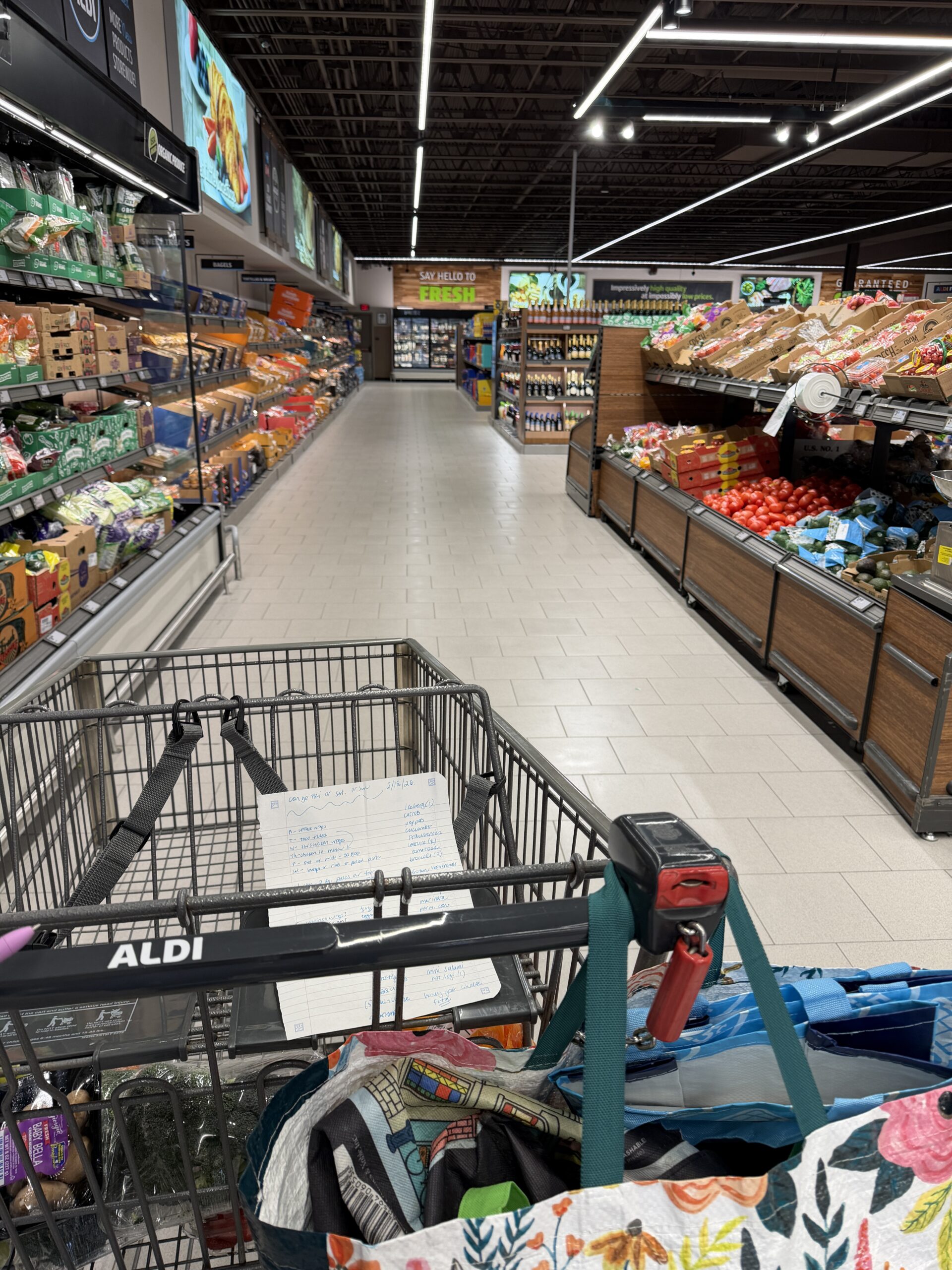
I’m just going to say it: if you’re not meal planning, you’re overspending. Period. Every extra store run, every “I don’t know what’s for dinner” panic at 4:30 PM, every last-minute takeout order — that’s money walking out the door.
Meal planning is the single easiest way to cut your food budget without changing what you eat. You don’t need fancy cook meal kits or a budgeting app. You just need to sit down once a week and answer one question: What are we eating for dinner this week?
Here’s what works for me:
- I plan 4 dinners per week. We eat at Grandma’s one night a week & she cooks. So generous! Weekends are for leftovers, easy dinners, or the occasional eating out – it’s fun to use some of that extra grocery savings on the occasional restaurant outing.
- I rotate a set of go-to meals my family actually likes — things like One-Pot Taco Pasta, Crockpot Chicken Alfredo, Instant Pot Beef Chili, and Sheet Pan Sausage & Peppers.
- I write my grocery list based on the meal plan. Not the other way around. This is the difference between a $90 shopping trip and a $160 one.
- I use my Meal Plan Matrix Cookbook system. It’s done for you, yet flexible.
This type of plan keeps you from buying random stuff that ends up rotting in the back of the fridge. Less food waste, less money wasted. I use my Matrix Meal Plan Cookbook for the done-for-you monthly dinner plans & then use the breakfast & lunch lists along with the grocery list generator once a week to fill in what we need. This takes me about 5 minutes weekly, now that I have the grocery list generator. Haha
[Insert Loom Video]
2. Shop at Aldi (or the Cheapest Grocery Store Near You)
I shop at Aldi almost exclusively, and it’s one of the biggest hidden costs people don’t think about — where you shop matters just as much as what you buy.
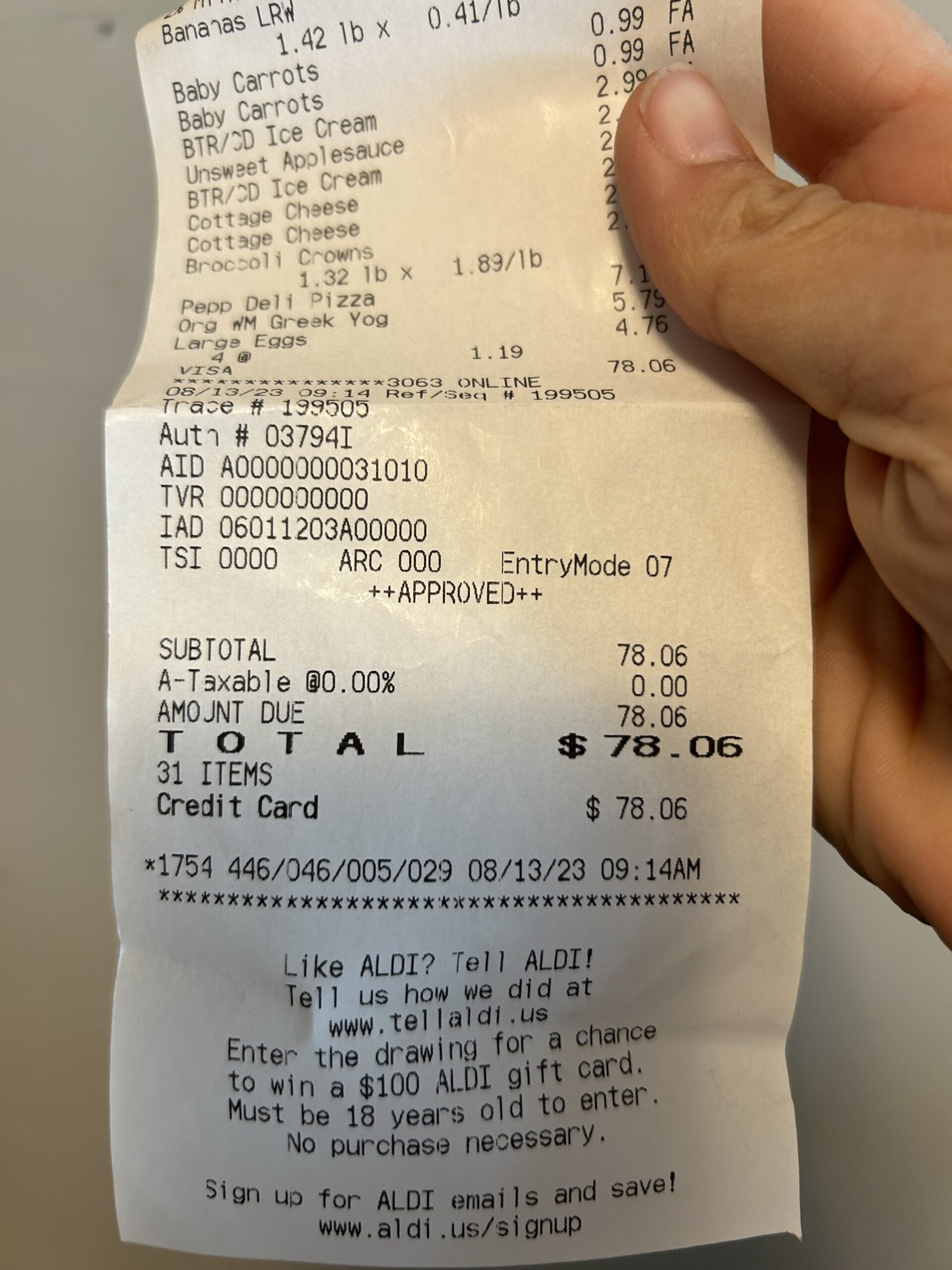
The exact same grocery list costs 30–40% less at Aldi compared to a regular grocery store. That’s not an exaggeration. I’ve price-compared. When you’re feeding a large family, that difference adds up to hundreds of dollars a month.
If you don’t have an Aldi nearby, look for the best deal at whatever store you have. Walmart’s Great Value line, Sam’s Club for bulk meat purchases, or even local discount grocery stores. The point is: stop shopping at whole foods and health food stores for your everyday meals unless your budget can genuinely handle it.
A little side note: I’m not anti–nice groceries. I love good food. But I’d rather spend $80 at Aldi on a week of home-cooked meals than $80 at a fancy store on three days’ worth of ingredients.
3. Build Meals Around Cheap Proteins & Batch Cook Smartly
Protein is the largest portion of a grocery bill for families of any size. So this is where smart adjustments make the biggest difference.
My go-to budget proteins:
- Ground beef — Tacos, chili, pasta, burrito bowls, Shepherd’s Pie. I mostly buy it Aldi these days, but you can get it in bulk at Costco or Sam’s; or source it locally.
- Chicken thighs — cheaper than breasts, more flavor, harder to overcook. I use them in a LOT from Crockpot Honey Sesame Chicken to Instant Pot Chicken Fajitas. Chicken thighs are 7g of protein / ounce compared to chicken breast, which is 9g/ ounce. So I use both!
- Whole chickens — honestly, I don’t love dealing with a whole chicken, but it’s so cost effective & flavorful, I do add them to our menu sometimes. If you roast one on Monday, you can do Instant Pot bone broth & use the leftovers for Chicken Fried Rice or Chicken Pot Pie Soup during the week.
- Pork tenderloin & cheap cuts — Aldi’s pork tenderloin is a great price per pound, and grocery stores often have it on sale at $1.99/ lb. I buy the little thin ones that have 2 pork tenderloins in there, totaling around ~3-4lbs meat. I cook them both in the same 9×13 dish. My favorite recipe is linked here – also titled Mom’s Easy Pork Tenderloin in my cookbook.
- Peanut butter — hear me out. Add peanut butter to make it more filling. For lunches and snacks, peanut butter is an incredibly affordable protein source. My kids eat it almost daily, and it costs practically nothing per serving.
When you batch cook proteins on the weekend — brown a big batch of ground beef, shred a crockpot chicken, marinate pork chops — dinner time during the week takes half the effort.
4. Keep a Well-Stocked Pantry
A well-stocked pantry is the secret weapon of every frugal meal planner. When you have pantry staples on hand, you can throw together easy recipes without making extra store runs (which always turn into $40+ “quick trips”).
My pantry always has:
- Rice (white rice and brown rice)
- Pasta (multiple shapes — we go through a lot)
- Canned tomatoes, tomato sauce, tomato paste
- Canned beans (black, kidney, pinto)
- Chicken broth
- Olive oil
- Soy sauce
- Salad dressings
- Taco seasoning, chili seasoning, Italian seasoning
- Peanut butter
- Oats
5. Keep a Fridge List – Paper, Dry Erase, or Skylight (and teach everyone to use it!)
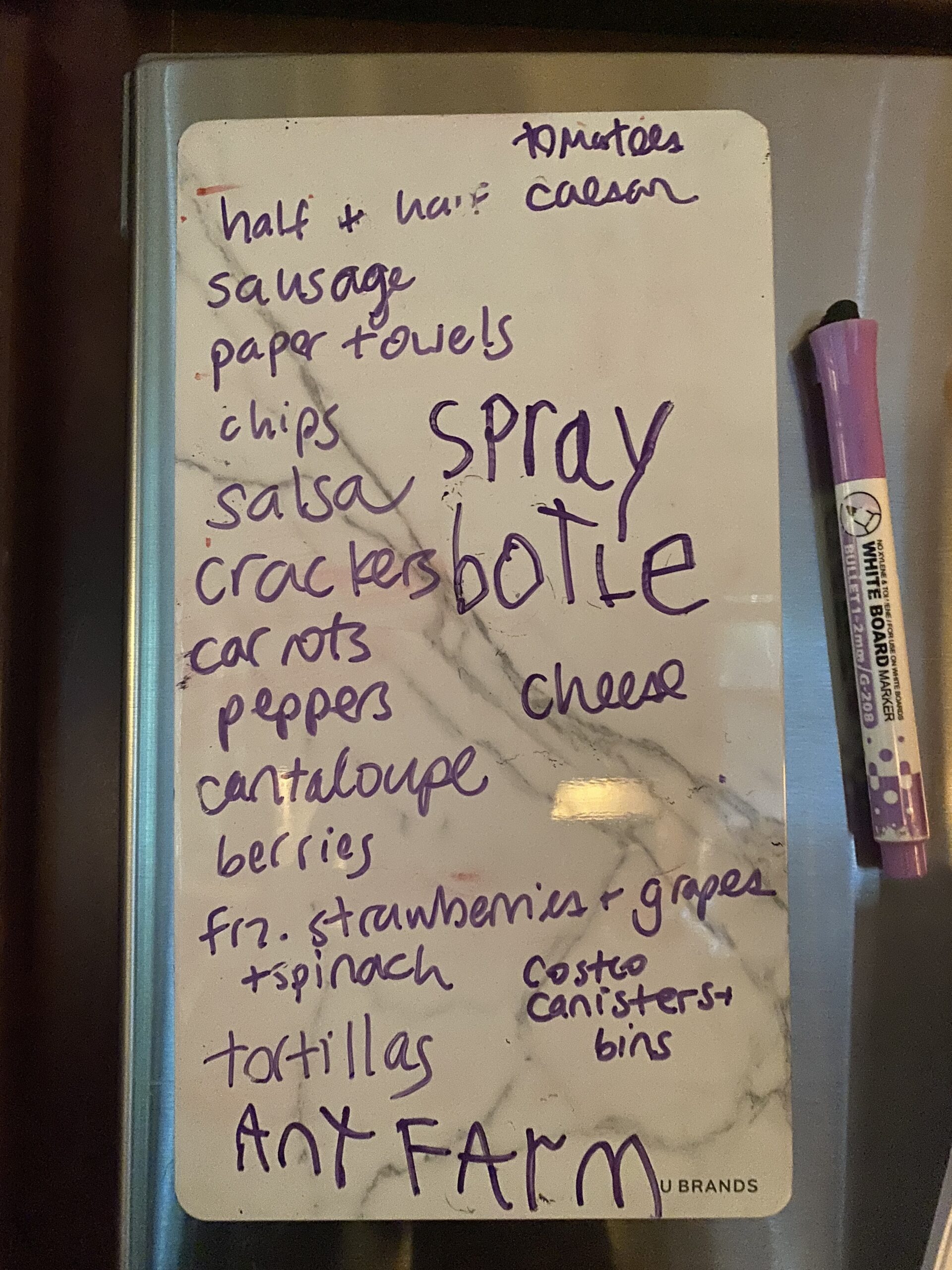
As soon as we’re running low on a pantry staple or anything else, I add it to my “fridge list.” (It used to be a magnetic fridge dry erase board pictured below & now we use our Skylight Calendar for it). I make sure to check the fridge list when I’m doing my Meal Plan Matrix Chat GPT grocery list….
A quick trip to the closest grocery store gets very expensive! The magic of the fridge list has seriously cut down on those last minute trips which has saved a lot of money over the years.
Everyone in our house adds stuff to the list. If you notice it or use it up, you are responsible for adding it. Which is adorable because the cutest things end up on my fridge list. We use our Skylight now but i sort of miss these hand written notes. Which ones do you think my 6 year old added?
6. Stop Buying Convenience Foods
This one’s hard to hear, but convenience foods and convenience snacks are budget killers. Pre-cut fruit, individual yogurt cups, snack packs, frozen meals, sugary drinks — all of it costs 3–10x more than making it yourself.
Some practical ways to cut convenience foods:
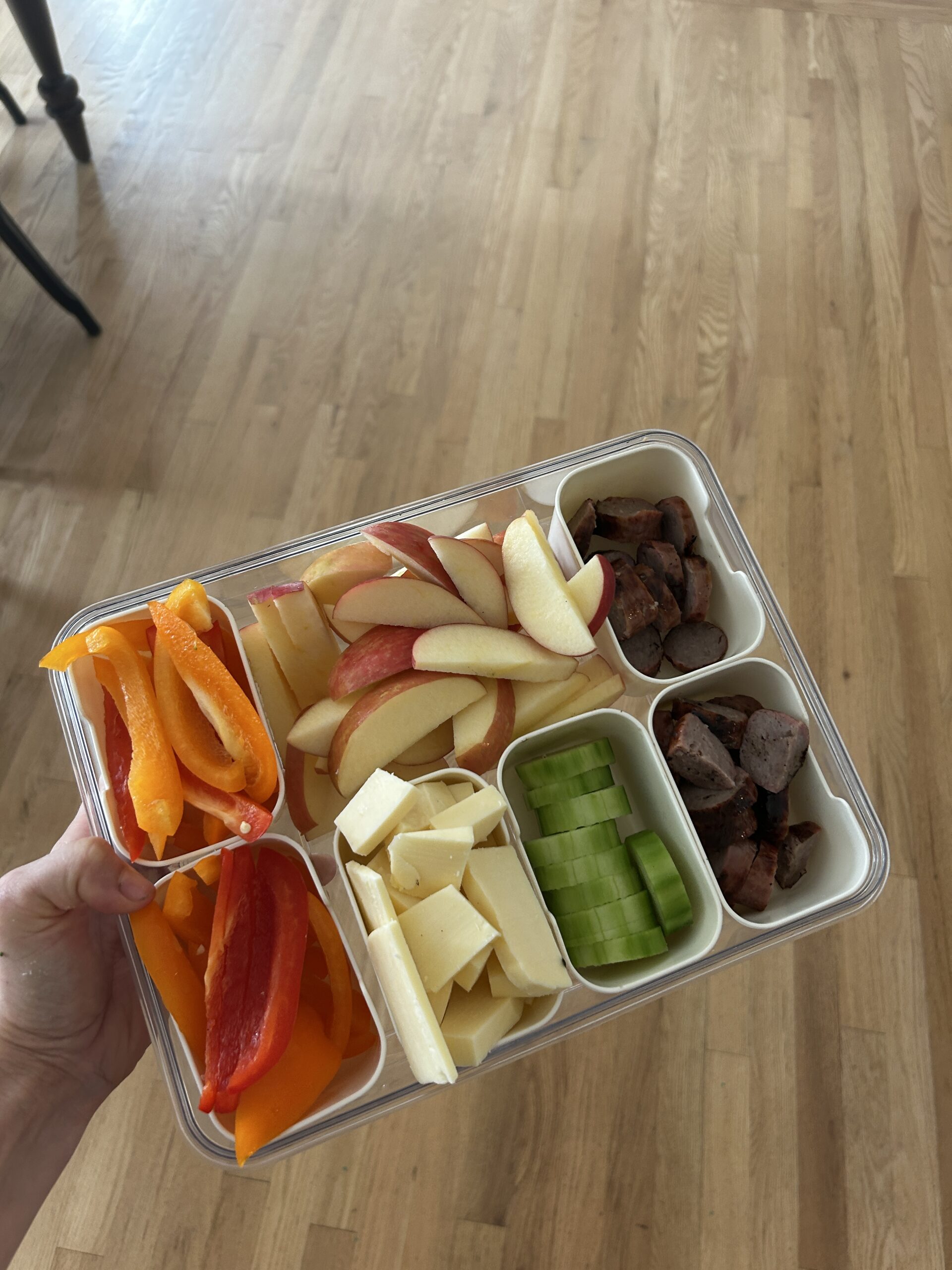
- Pre-chop veggies yourself on Sunday. It takes 15 minutes and saves $10-20 per week compared to buying the same amount of pre-cut. Except carrots, I buy baby carrots for snacking and big ones for recipes.
- Pack lunches from leftovers instead of buying lunch ables or deli trays or charcuterie trays.
- Make your own cream soups — a can of cream of chicken soup costs $1.50+. Making it from scratch costs about $0.30 and takes five minutes.
- Skip fast food. A single fast food run for a family of 7 costs $40–60. That’s nearly a full week of dinners at home.
- Buy fresh produce in season and freeze what you don’t use. A lot of fresh fruit is half the price when it’s in season, and it freezes beautifully for smoothies. I actually buy frozen fruit for snacks and smoothies too. But not the smoothie convenience packs. Those are wayyyy more expensive.
I’m not saying never buy a bag of chips — we’re human. But having prepackaged snack packs (especially the “healthy ones” as the backbone of your grocery cart is a great way to blow your budget without actually feeding anyone anything substantial. LOL
7. Use a Consistent Weekly System
The best planning in the world falls apart without consistency. Here’s what a consistent week looks like in our house:
- Thursdays: grocery planning
- Thursday before the 1st of the next month: Use meal plan matrix to fill out the entire month’s dinners & use the custom chat gpt to move things around if needed based on our schedule/ travel/ etc.
- Every Thursday Afternoon: Double check that monthly meal plan & generate weekly grocery list in the custom chat gpt – print it out or copy/ paste in phone notes if you’re a digital list person. Stand in my kitchen & cross out what I already have on hand.
- Friday or Saturday: One shopping trip to Aldi per week. One store. No extra store runs. If Aldi doesn’t have something I absolutely need, I order from or stop at Walmart.
- Sunday or Monday 1 hour: Sometimes I use the Matrix Meal Plan weekly prep sheet to batch prep!! Sometimes I skip this… depends on how busy we are those weeknights.
- Monday–Thursday: Cook dinner using the plan. No guessing, no scrambling, no last-minute takeout. Friday or Saturday we sometimes do a date night or fun takeout night or we eat leftovers.
This type of plan keeps our busy family life running without dinner time becoming a daily crisis. And because I’m not making extra store runs or impulse-buying in the parking lot while hungry, our food dollars stretch so much further.
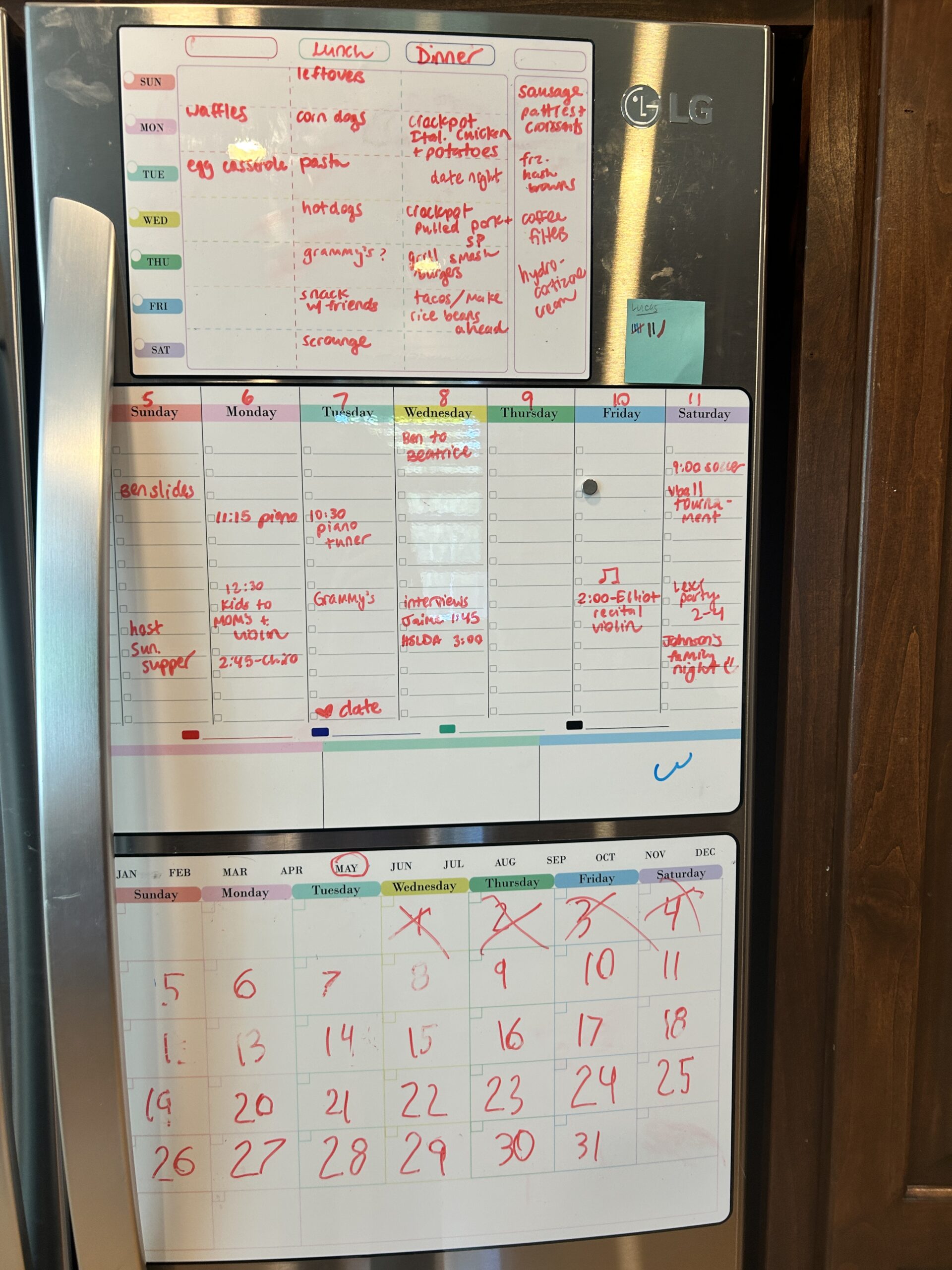
In terms of where to write everything… We used to use the system pictured below, but someone gifted us this 15″ Skylight calendar– I’m not going to lie; it’s amazing. I don’t pay for any of the premium stuff, I just use TASKS for kids’ chores, LISTS for grocery & other lists, and the calendar tied to my google calendar so everyone can check the schedule on their own.
Anyway, this $25 magnetic setup worked too!! for years. (Linked similar; they don’t have mine anymore since I bought it so long ago.)
7. Embrace Leftovers and Flexible Meals
Leftovers aren’t sad — they’re strategic. Every leftover ingredient is one less thing you have to buy next week. I try to throw out as little food as possible.
Here are some of the easiest ways to use them:
- Leftover chicken becomes Chicken Salad, quesadillas, or Chicken Fried Rice
- Leftover ground beef becomes Walking Tacos or Hamburger Helper Homemade
- Leftover veggies go into a frittata, soup, or fried rice
- Leftover rice becomes a side dish or gets tossed into a burrito bowl
I also keep a list of “flex meals” — inexpensive meals that use whatever’s left in the fridge. Things like Breakfast for Dinner (eggs are cheap!), Nachos, English Muffin Pizzas, or Quesadillas with Leftover Chicken. These are affordable meals that feel fun & frugal.
8. Track Your Spending (Even Loosely)
You don’t need a fancy budgeting app, but you do need to know what you’re spending. We’ve used YNAB to track our spending for YEARSSSSSS. I refer everyone who wants to actualyl budget to it.
You can also use a cash envelope for groceries. Put $50s in so it’s easy to track. Or you can just use an empty envelope with your credit/ debit card but write the amounts on the envelope as if it’s cash.
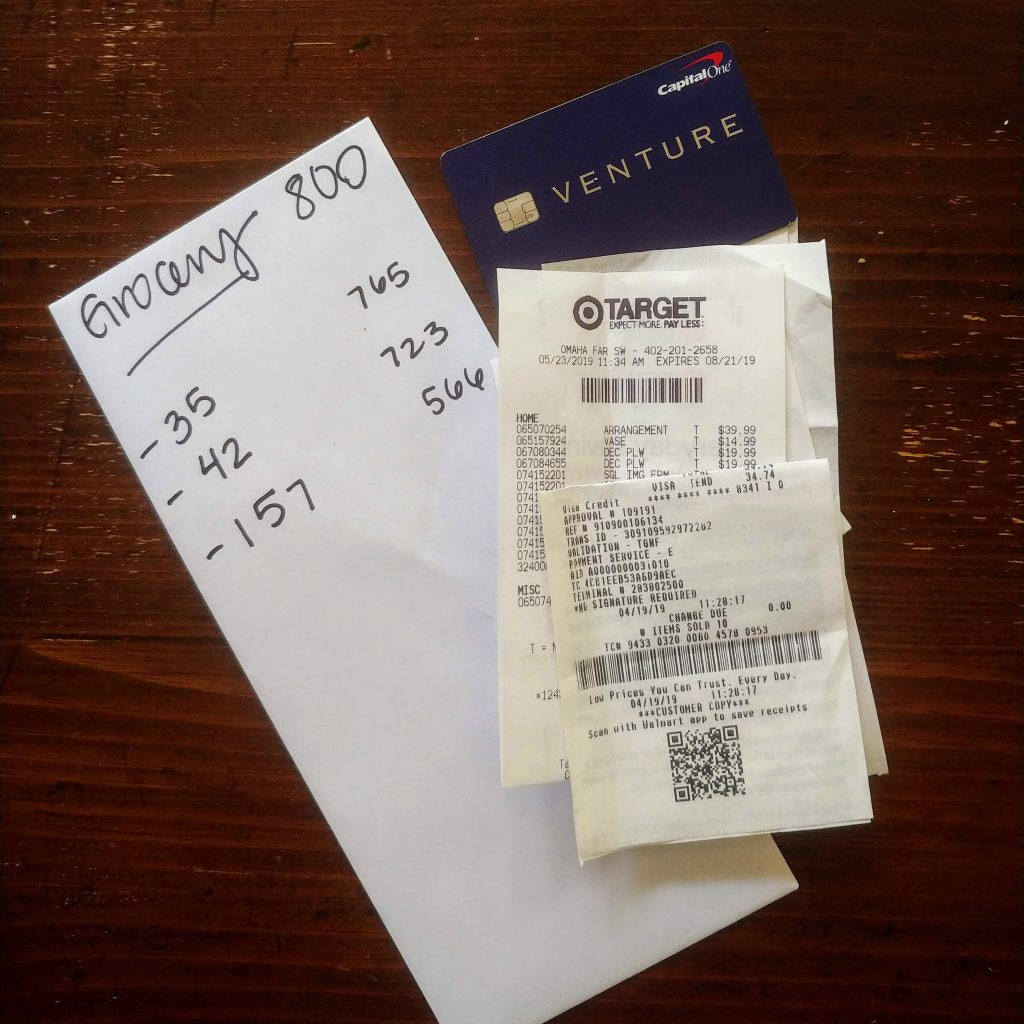
Or keep it super simple: save your grocery receipts in a little drawer or console in your car and add them up as you go. (Same thing with the envelope above.)
When you start tracking, you’ll be shocked at how much money is going to things you don’t even need or really want — random snacks, duplicate pantry items you have, things you can buy cheaper online, impulse buys, etc.
Those small changes — cutting even $15–25 a week — add up to $60–100 a month. That’s a realistic food budget shift that doesn’t require eating ramen every day.
Want the exact meal plans I use?
My Meal Plan Matrix cookbook has a year’s worth of own meal plans built for budget-conscious families — with realistic plans, healthy recipes, weekly prep guides, protein counts, and a custom grocery list builder.
Almost everything in the cookbook can be purchased at Aldi.
And the weekly plans are for normal people… who use a variety of simple meals like tacos + more fun meals like Hawaiian marinated pork chops + freezer meals like baked ziit + grilling marinades, instapot, crockpot and more.
It’s the easiest way to stop guessing and start saving. No more dinner stress, no more overspending.
Get the Meal Plan Matrix here →
You Don’t Have to Be Perfect — Just Consistent
Here’s what I want you to walk away with: feeding a large family for $400 a month isn’t about deprivation. It’s not about clipping 200 coupons or eating the same three meals on repeat. It’s about having a system — a weekly meal plan, a reliable grocery store, a well-stocked pantry, and a handful of easy recipes your family actually enjoys.
Start with one small improvement this week. Plan four dinners. Make a grocery list. Skip the extra store runs. Every consistent week builds on the last, and before you know it, you’ll wonder how you ever did it any other way.
You’ve got this. And your wallet is going to thank you. 🤍