

Some of the links on this page are affiliate links. When you make a purchase through an affiliate link, I earn a commission at no cost to you. See my entire disclosure policy for all the boring details.
This post contains affiliate links, which means I may receive a small commission, at no cost to you, if you make a purchase through a link. As an Amazon Associate, I earn from qualifying purchases.
Can we talk about bedtime for a second? Because if you have small children, you KNOW how absolutely CRRAAAZY bedtime can get!! We have 5 kids, and trust me when I say I’ve seen it all. “I need one more drink” requests that never end, the missing blankies, the toothpaste-spitting contests (yes, really), and the endless parade of little feet coming out of bedrooms asking for “just ONE more thing.”

While I can’t promise to eliminate ALL bedtime drama at your house (wouldn’t that be nice!?), having a consistent bedtime routine in place – complete with a simple picture chart – can seriously help the little people in your life stay on task at bedtime.
We’re not aiming for perfection here… we’re just trying to get from teeth brushing to pajamas without ending up in tears or losing our minds, ya know!?
I’ve boiled it down to 5 steps that ANYONE can make work for his or her family! And honestly, once we got this system working, bedtime became SO much easier. (And by easier, I mean most nights. Let’s be real – there are still those nights where everyone is overtired and it all falls apart. But MOST nights? So much better!!)
1. Decide Your Bedtime Priorities
First things first – you have to figure out what exactly you want accomplished at bedtime. What do you NEED to be part of your bedtime routine?
This may or may not include any of the following:
- Brushing teeth
- Pajamas
- Snack
- Room tidy
- Showers/baths/brushing hair/hanging up towels
- Reading bedtime story
- Snuggling/hanging out/chatting
- Prayer or quiet time
- Packing backpack for tomorrow
- Laying out clothes for the next day
Here’s the thing – there are NO right or wrong answers in terms of a bedtime routine! You just can’t do ALL the things unless you want regular bedtimes to take 60+ minutes. (And honestly, who has that kind of energy at the end of the day!?)
For example – we used to do a warm bath before bedtime several nights a week PLUS read a couple books. When we had 2 kids and their books took 3 minutes to read, this worked fine.
Within a few years, we had 4 kids that couldn’t all fit in the tub together. AND some of their book choices took 10-15 minutes. AND we started reading chapter books as family read-alouds.
All of the sudden, it took 2 shifts in the bath, the bathroom was a DISASTER with water, wet towels and dirty clothes everywhere, and THEN we had 60 minutes worth of reading to do!? No wonder bedtime felt stressful and exhausting.
So we re-prioritized and shifted bath time to earlier in the day and prioritized reading before bed.
But then, during the summer, when the kids wanted to stay outside playing late, we moved our extended read-aloud time to after breakfast and we went back to showering before bed.
Major Takeaway: You can have a regular bedtime routine AND shift it depending on what’s going on in life.
Evaluate what you really want to prioritize at bedtime RIGHT NOW, for the season of life you’re currently in, and exclude everything else from the bedtime routine list. A toddler bedtime routine will look totally different than a good bedtime routine with older children or school-aged children.
Your family’s needs change as your kids grow, and that’s completely okay!! In fact, we’ve tweaked our bedtime routine probably a dozen times over the years as our kids have gotten older and our family has grown. What worked for one or two preschoolers definitely doesn’t work for five kids ranging from toddler to tween!!
(Side note – if you have a baby or toddler who’s struggling with sleep, I put together a whole guide on helping little ones learn to sleep well. You can check out my Goodnight Baby guide here – it walks through everything from wake windows to bedtime routines for the littlest ones!)
2. Address Your Problem Areas
Okay, real talk time. What needs to CHANGE about your current bedtime routine situation?
- Is there a bunch of sibling bickering?
- Is bedtime dragging on and on with children coming out of their room after you put them to bed?
- Are you looking all over the darn house for that favorite blankie every single night? (Why is it NEVER in the bed where it belongs!?)
- Is someone waking up in the middle of the night?
- Are there bright lights keeping everyone awake?
- Is someone having night terrors?
- Are people not getting enough hours of sleep?
- Do you find yourself YELLING by the end of bedtime? (No judgment – I’ve been there too many times to count!!)
If there is an obvious frustration, jot it down and figure out how you can address it proactively.
Healthy sleep habits are a really important thing for kids AND adults in your home. Sleep problems make life hard on EVERYONE, so I’m all about solving bedtime problems as soon as possible. Because a tired mama is not a happy mama, and tired kids are… well, you know!!
Example Bedtime Problem #1
Recently, I was getting SO irritated that we’d get the kids into bed every night and all 3 of the big kids would melt down because they couldn’t find their reading lights and/or water bottles and/or favorite blankie. And I was TIRED because it was the end of the day and I just wanted to be DONE with bedtime, you know?
Solution – I drew a picture of everything they were constantly asking ME to get for them after bedtime and posted it on the bathroom mirror. For several weeks we reminded them to check the list and make sure they had everything in their beds because once lights were off, it was too late!! This list was a great way to help the kids take responsibility in an age-appropriate manner.
And guess what? It worked!! After a couple weeks of reminders, they started checking the chart on their own. (Most nights, anyway. Like I said – we’re aiming for progress, not perfection!)
Example Bedtime Problem #2
Our kids had turned teeth brushing into a toothpaste-spitting contest which inevitably left the bathroom disgusting and someone crying because someone else spit toothpaste on their face. Gross!!
I was SO over scrubbing toothpaste off the mirror every single night. And the tears? And the fighting? Just… no.
Solution – 2 kids brush teeth while the other 2 put pajamas on and find reading lights/books. Then switch!!
This simple change eliminated the crowding and the competition. Problem solved! (Well, mostly. They still make a mess sometimes, but at least there’s no more toothpaste-spitting warfare!)
Major Takeaway: Make sure whatever new bedtime routine chart you create addresses the SPECIFIC problems that are most frustrating right now!!
Don’t just copy someone else’s routine – make it work for YOUR family and YOUR specific challenges. Your bedtime struggles are probably different than mine, and that’s okay!! Figure out what’s driving you crazy and tackle THAT.
3. Make a Routine Chart
After you decide your new bedtime routine, write it out in as few steps and words as possible.
Since our 4-year-old can’t read all the words yet, I drew a picture for each step. (And by “drew,” I mean stick figures. VERY simple stick figures!!) Your chart might have more or fewer items than mine!!
Just do what works for you, friend.
Here was the super simple bedtime chart we posted for our 4, 6, and 7-year-olds. (Our 2-year-old’s bedtime routine was slightly different and carried out by an adult.)
I thought about making this all fancy and digital and customizable for you, but a quick stick-figure drawing on some scratch paper was easier for me, so I figured it’d be easier for you too!! Feel free to copy any of my really “artsy” drawings 😁
Getting fancy bedtime routine cards isn’t what is going to make or break this system! Success will depend on keeping things SIMPLE.
Seriously – don’t overthink this part. Grab a piece of paper, draw some simple pictures (or write words if your kids can read), and tape it to the bathroom mirror. Done!! You don’t need to laminate it or make it Instagram-worthy. You just need it to WORK.
4. Make an Announcement (NOT at Bedtime!)
Call a “family meeting” earlier in the day and explain the change in bedtime routine.
The first key here is to have this conversation at a time when it’s NOT a current, in-the-moment issue.
Don’t announce the new bedtime routine right at bedtime when the drama has already commenced!! (Trust me on this – I learned the hard way!) Try bringing up the new plan during a snack or mealtime earlier in the day.
When we posted our most recent bedtime routine chart, we mentioned it at dinner. Everyone was calm, fed, and in a decent mood – perfect timing for this kind of conversation.
Here’s the second key to this announcement: use “alpha speech.”
Alpha Speech is a term coined by John Rosemond to describe a calm, authoritative, but loving, no-nonsense style of communication parents with well-behaved children use. He explains it in full in this article, but here’s an excerpt describing the basic gist:
Alpha speech in four parts: (1) When giving instruction to a child, speak from a fully upright position (as opposed to the silliness of “getting down to the child’s level”). (2) Use the fewest words possible. (3) Do not explain yourself, but simply tell the child what you want him to do in a matter-of-fact tone. (4) When a child wants to know “Why?” (which is what children ask in the absence of an explanation), your answer should be “Because I said so” or a variation thereof.
For example, if you want a child to put on his coat and wait by the front door, you say, “I want you to put on your coat and wait for me by the front door.” You DON’T say, “I have to go down the street and give a casserole to Miss Gloria, and it would really help Mommy if you’d put on your coat because it’s chilly out and wait for me by the front door.” That approach is likely to draw resistance of one sort or another.
Alpha speech is nothing more than saying what you mean and meaning what you say. It is employed by effective leaders, thus the alternate label. It is neither threatening nor promising. Oh, and when the child obeys, it is best to say simply “Thank you” without an exclamation point, as opposed to “Good boy! Mommy’s going to take her little man to the ice cream store later today!”
Use alpha speech to communicate that bedtime hasn’t been working well lately and you’re going to change some things around.
We said something like: “Hey kids, there’s been a lot of craziness at bedtime lately. Lots of missing reading lights and coming out of bed for drinks and crying over toothpaste spitting. We end up frustrated or losing our temper and you often end up crying or losing privileges. So we made a new chart to help everyone stay focused on their own responsibilities at bedtime. That way, you’ll have plenty of time to find your lights and water before bed and we’ll have our time together after you go to bed. This will help everyone get a better night’s sleep in your own bed.”
Short, clear, and to the point. No guilt trips, no over-explaining, no asking permission. Just stating the facts and the new plan.
5. Set Expectations and Attitudes
Using alpha speech as described above helps you as the grownups to maintain a calm, cool, collected tone. (Which, as we all know is HARD to do sometimes, even as adults!! Haha!!)
We try to keep these types of family conversations short and sweet. As your kids get older, you might involve them more. But for kids under 8 or 9, where the parents are still largely in charge of the whole bedtime routine situation, short and simple is usually easier.
It’s important to set reasonable expectations for yourselves AND your kids.
4 Expectations for the Adults
1. PRACTICE – This new system will take time for the kids to learn. It won’t magically happen overnight. We’ll have to teach and re-teach what we expect before it all clicks. Give it at LEAST two weeks before you decide whether it’s working or not!!
2. TIME – Bedtime may take anywhere from 5-60 minutes depending on what you chose to prioritize. If you’re going to include a bath, bathroom cleanup, and stories, don’t be surprised when your bedtime routine takes 45 minutes. Just plan for it to take 45 minutes ahead of time and you’ll be less likely to be irritated when, in fact, it takes 45 minutes!! (If you want bedtime to be a shorter, simpler affair, move some of the things on your list to other times of day.)
3. ALPHA SPEECH – Practice it!! Think before you speak and communicate to your children, and then be clear, specific, and skip the fluffy questions. (i.e. “Aren’t you so sleepy and ready for some cozy jammies and storytime? You love storytime!”) Eventually, alpha speech becomes second nature, but if it’s new to you, you might want to practice or think through exactly what you’ll say. Otherwise, you’ll probably resort to coercion, which inevitably fails and leads to yelling. (Been there, done that, got the mom-guilt t-shirt!!)
4. SIMPLE, NO-FUSS – You don’t need an elaborate system of stickers or consequences to implement a new bedtime routine. Just post the picture chart so that everyone is clear on the expectations, make the announcement, and work on teaching this new process over the course of a couple weeks. The intrinsic reward will come with happier, simpler bedtime for all.
There is a time and place to implement consequences… That’ll be explained at the end of this section.
3 Expectations for Kids
1. CHILDREN ARE NOT IN CHARGE OF BEDTIME – Again, this is really geared towards younger children. As your child turns 9, 10, 11+ you probably will shift to allowing them to be in charge of more and more things at bedtime. But for young children, parents should be in charge of the general bedtime routine.
Kids can be in charge of SOME things, of course!! Personally, we let our kids decide whether or not they want to wear pajamas. (Weird to some, but we just don’t care if our kids wear pajamas or not. They can wear whatever they want to bed.) We also let our kids decide about whether or not they want their bedroom door open.
If you were a fly on the wall in our home, you’d frequently overhear us reminding our kids, “I know you don’t want _, but you’re not in charge of that decision.”
We talk a LOT about what they ARE in charge of and what they’re NOT in charge of. You, the parent, can be in charge without being an evil dictator AND while still allowing your child a lot of freedom and decision-making. In fact, young children feel MORE confident when they know their parents are the ones in charge.
This was a game-changer for us when we realized it. Our kids actually relaxed and cooperated better once they knew WE were steering the ship. They didn’t want that responsibility – they just wanted to know the plan and follow it!!
2. COOPERATE QUICKLY AND WITH A GOOD ATTITUDE – It’s okay to be disappointed, but it’s also important to train yourself to do things you don’t want to do with a good attitude. No one enjoys being around a sulky sourpuss.
This is true for adults AND children. Sometimes I point out to my kids throughout the day, “Man, this is a good example of something I REALLY don’t want to do, but oh well. Gotta get it done anyway!” It’s part of life and it can be practiced by children from a young age. (Not perfectly, of course!! But just little by little over time.)
3. HAPPY PARENTS – Instituting a calm bedtime routine that works for your family will inevitably help parents to stay calm and happy at bedtime. I really never want to put my kids to bed when I have a crabby attitude because I don’t want to let the sun go down on my anger. It’s SO much sweeter to close out each day with a genuine hug or snuggle rather than yelling at everyone and slamming the door. (Please tell me I’m not the only one who’s done that before!? #momfail)
One Exception to the No-Rewards/Consequences Mentioned Above
If there has been a TON of bedtime drama lately, you might choose to remove most items from your child’s room. I got this hack from John Rosemond. We did this once with our oldest when she was 4.
Bedtime had gotten OUT of hand. One more toy, one more kiss, one more hug, one more drink… if we said no to something, dramatic tears ensued.
The core of the problem here was we had slowly let our 4-year-old become in charge of bedtime, and she just wasn’t old enough for that. Once we took charge of bedtime again, everyone was MUCH happier… including our 4-year-old!!
Here’s how we tackled the issue. (This plan was formed after reading The Well Behaved Child by John Rosemond. He has SO much great, practical parenting advice for families who want to be happy together. I highly highly recommend this book!!)
One day, while our 4-year-old was with Grandma, we took everything out of her room except her bed, comforter, pillow, favorite blankie, a nightlight, and 5 or 6 books.
At some point that afternoon, we said something to the effect of, “You are making too many requests at bedtime and throwing too many tantrums. Mom and Dad are in charge of bedtime, not you. So here are the new bedtime rules. (We pointed to top row on the new routine chart.) There is no calling out for extra things, no throwing fits, and no asking for things when you come out to go potty.
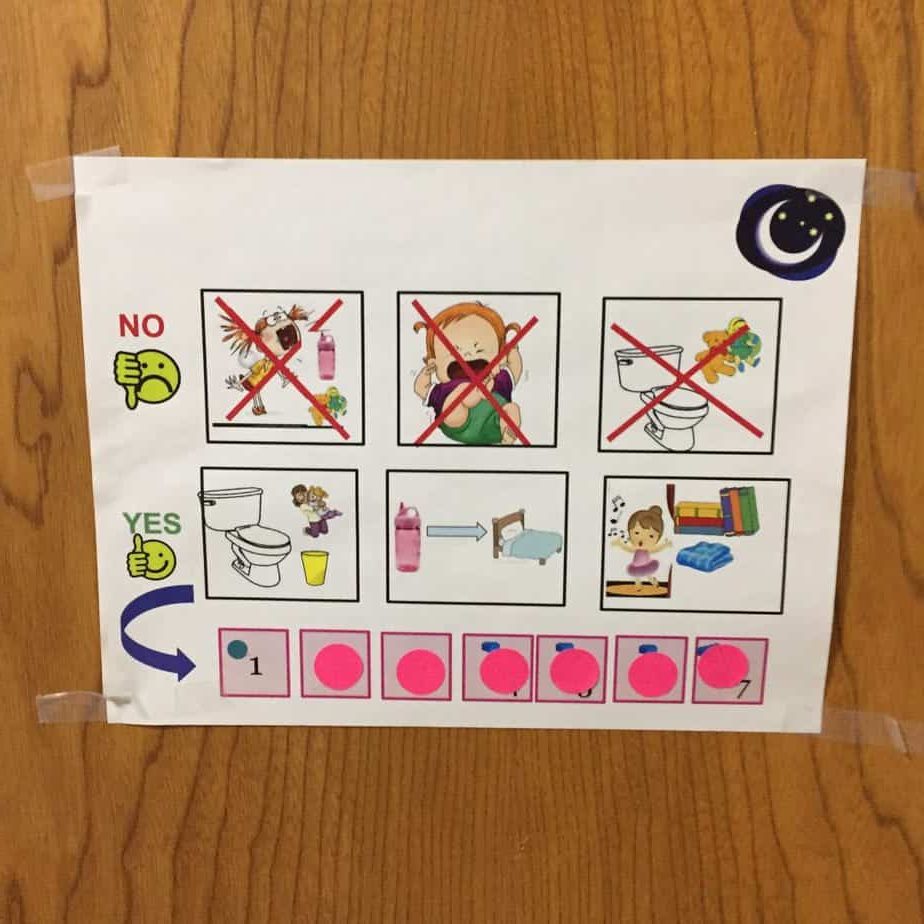
(Then we pointed to bottom row) You may…
- Come out to go potty.
- Get a drink in the bathroom or bring your water bottle to your room before bedtime.
- Give a hug when you go potty.
- Sing and read in your room until you are sleepy.
We took all the toys out of your room. Your books, blankets, and stuffed animals are still there. If you follow the rules, then in the morning you can put a sticker on a box. If you get stickers 7 days in a row, then you will get your toys back.”
(Generally, we try to stay away from these types of sticker chart behavior things, but they can be helpful for establishing new habits and routines.)
She cried briefly when she realized her toys were gone, but honestly, this fixed bedtime issues almost IMMEDIATELY. She was SO much happier. She read and sang in her room most nights and fell asleep sooner than before. After this experience, we implemented the 3-toy rule for our children’s rooms and haven’t looked back.
Once we as parents took control of bedtime again, everyone was happier. Including our kid!!
A Couple Other Random Tips
Here are some other things that have helped make bedtime smoother at our house:
- A set bedtime helps. Our kids mostly go to bed around 7:30pm. Now that they’re older, it’s a little more flexible sometimes. But younger kids have a HARDER time with random bedtimes. Consistency really does help their little bodies know when it’s time to wind down.
- We let each kid have a dim night light if they want. Some of ours use them, some don’t. Whatever helps them feel comfortable!!
- We LOVE a white noise machine or fan for background noise in everyone’s room. This has been a lifesaver, especially with 5 kids in the house. It helps drown out sibling noise and creates a consistent sleep environment.
- No screens – just search it on the internet. Screens in kids’ rooms will cause a LOT of extra sleep problems. The blue light messes with their melatonin production and makes it harder to fall asleep.
- We don’t even use screens as part of the bedtime routine. Period!! Some families do a show before bed, but we found it just revved our kids up instead of calming them down.
- Quiet activities allowed in bed – it seems to help our kids wind down. They all have some coloring, books, etc. We tell them they don’t have to sleep, but they do have to stay in bed and do quiet activities. Usually they fall asleep within 15-20 minutes!!
Give Everyone Time to Adjust and Tweak as Needed
Last thing, friend – posting a checklist on the bathroom mirror isn’t magically going to create peaceful bedtime angels at your house.
At least, that didn’t happen at OUR house!! (I wish!!)
We had to stand in front of the chart every day for a couple weeks with our kids and walk through the whole routine with them until they figured out how to do it more independently.
Sometimes we fall out of the habit of utilizing the chart, and we have to hit reset and start over.
There are days where we’re all tired and cranky and just need to be in bed as soon as possible. Do not pass go, do not collect any bedtime stories!! Ya know!? It’s part of family life.
But hopefully, this bedtime routine post inspires you to think through your children’s bedtime routines and readjust as needed!! Even small tweaks can make a BIG difference in how smoothly bedtime goes.
If you have toddlers at home, here is a super detailed article about sleep issues specific to toddlers with TONS of solutions to help your toddler (and you!) get enough sleep at naptime and nighttime!!
And remember – progress, not perfection!! Some nights will go great, some nights will be a hot mess. That’s just life with kids, and that’s okay. Keep showing up, keep being consistent, and over time you’ll see improvement.
You’ve got this!!
xoxo,
~ Renee